Hello from Kenya, where I spent the last two weeks in meetings and workshops.
Together with some of our engineers, I am currently in Nairobi for the sprint of the AI for Global Development Accelerator, three packed days of building alongside other teams working on AI for the majority world.
Thanks for reading All things highdigenous... and more! Subscribe for insights and stories from the frontier of AI and Human Flourishing.
This edition covers three things we have been working through: why a WorkTech like Kabakoo has set up a Textile Lab, how we are using WhatsApp to fast-track social capital building for youth; and what our data says about designing for young women in the Sahel, following my contribution at a recent World Bank’s seminar.
Our jam of the month is “We Have Got To Progress On” by Slim Ali and the Hodi Boys, a song from their 1970s record “You Can Do It.” We already shared another song of that LP long ago with you. Our newsletter O.G. might remember. It’s a record full of optimism and the mindset required to go through the hardships of life. Yes, we all have got to progress on something.
Kabakoo is a research and implementation WorkTech headquartered in Lomé and Bamako. We design and scale evidence-based pathways for West African youth, integrating AI, community, and cultural insights to foster the mindset and skills essential for achieving economic mobility and driving systemic change in informally dominated economies.
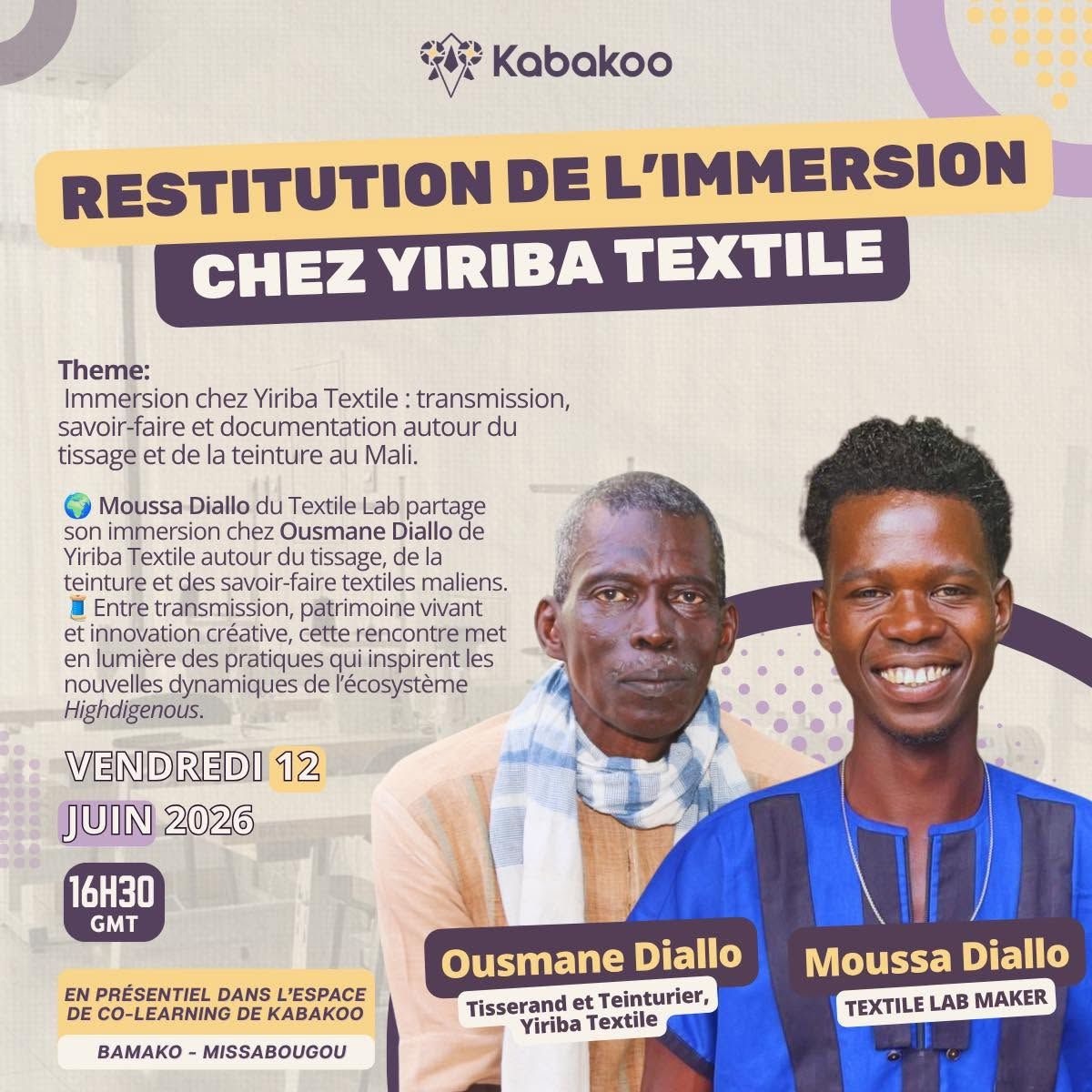
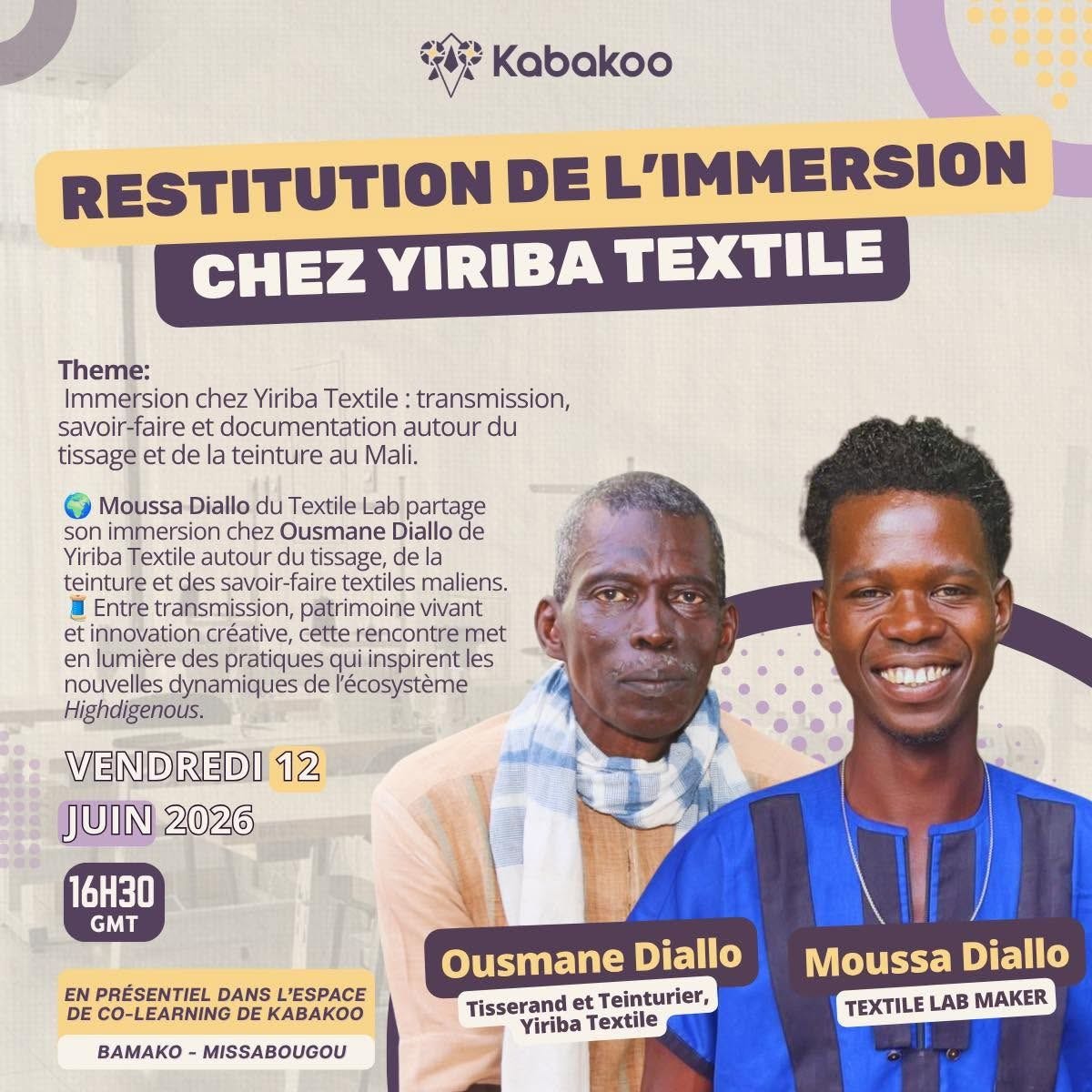
Earlier this month we held a public session to present the first learning cycle of our Textile Lab, after several weeks of immersion in the workshop of Ousmane Diallo, master weaver and one of the last natural-dye experts in Mali.
First, some context on the Textile Lab.
“Where did you buy this?” We get this question almost every time we travel, about the clothes we wear. From Nairobi to New York, people are drawn to the beauty of the cloth: the deep indigo blues, the calm earth tones, the texture of handwoven fabric.
That cloth is the result of centuries-old knowledge and sophisticated craftsmanship. It is the result of the weaving techniques, the plants and their wellbeing properties, and the natural dyeing processes.
Yet the ecosystems that produce it remain fragile. The products attract attention, but artisans face two hard problems. They struggle to attract younger generations, and to reach markets beyond tourism and cultural demonstrations. For Kabakoo as a WorkTech dedicated to opening avenues for economic value creation, productivity, and employment by and for the youth, that raises a real question. If we recognize the knowledge and craftsmanship embedded in the endogenous textile value chain as a source of prosperity, how do we make sure youth can use it to generate and enjoy economic value?
To explore that, we created the Textile Lab, a research, experimentation, and co-creation platform for understanding how the knowledge systems across West Africa’s textile value chains can inspire new forms of upskilling, and generate real economic opportunities.
Like our other labs, the Textile Lab’s work too begins with intergenerational transmission, learning, and documenting. It’s about the materials, the production processes, the people involved, the diversity of knowledge in their practice, the challenges they face, and the markets and cultural narratives around them. Experimentation comes next. We bring together artisans, designers, and makers to explore new products, new uses, new learning experiences, and how design, technology, and collaboration can amplify value.
Presenting the Textile Lab’s first learning cycle at Yiriba Textile, Bamako.
This first cycle also showed, concretely, the innovation already happening inside the workshops. Ousmane, for instance, constantly experiments with weaving techniques, develops new motifs, and refines natural dyeing processes that he is one of the few artisans still able to master. He even brings in engineering, adapting technologies like the Flying8 loom to raise his productivity.
And Moussa, our Textile Lab Maker, was able to document, photograph, and record every step, from weaving to plant-based dyeing.
The Highdigenous Talks series we discussed in last month’s update connects directly to these immersions. A Highdigenous Talk is usually the first step in a collaboration between a master craftsperson and Kabakoo. Between Ousmane Diallo’s Highdigenous Talk and his welcoming our Textile Lab Maker into his workshop, almost three years passed, during which we were able to build and nurture the necessary trust.
Why do we put resources into this? It’s an efficient way to make these skills legible, reproducible, and transmittable to future cohorts of learners.
To use WhatsApp for structured social-capital building, we are testing a system of AI- and human-facilitated pods. Each brings learners into small groups of three to five, matched on shared interests and geographic proximity, to work together on concrete projects. This follows our earlier works on the topic that we reported here last year.
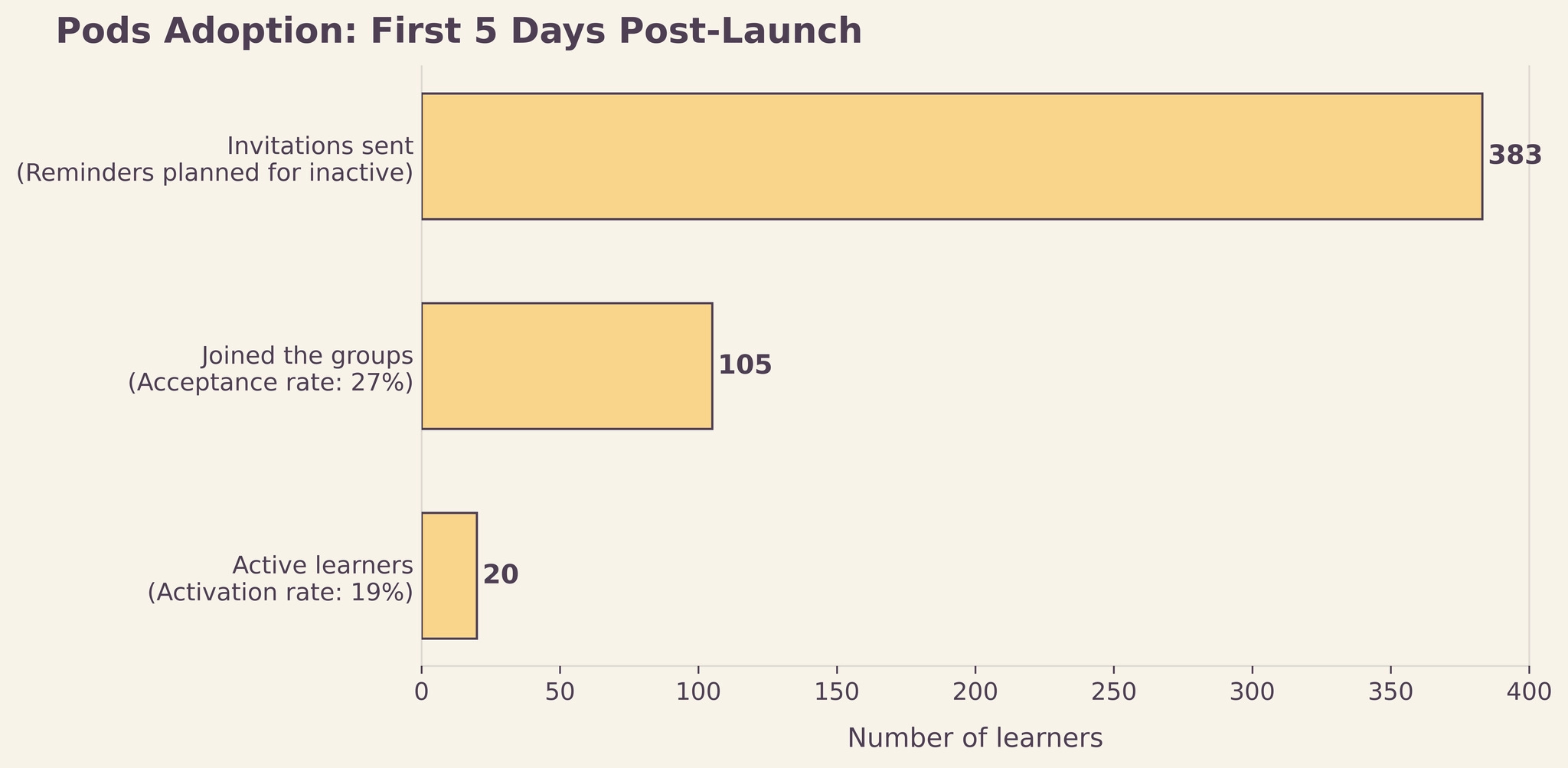
116 pods have been created five days post-launch. Of the 381 learners invited to join a pod, 123 have accepted and joined their assigned group, an overall pod-integration rate of 32.3%. The rest will get a reminder. For those who still don’t join after that, we will make follow-up calls to understand why.
Among the learners who joined, 27% have already sent at least one message in their group, an early sign of active participation. At the pod level, 20 of the 116 pods (about 17.2%) currently have at least three members who have joined. The full distribution is below.
The most interesting surprise came from our AI Mentor, which is integrated in every pod. It turned out to be a little too eager to help. It sometimes jumped into a conversation even when it was only mentioned indirectly, not clearly called. This raised a fun but real product question: is that a bug, or could proactive support sometimes be useful? It also reopened our debate about using “@” to call the AI Mentor in WhatsApp groups. We had avoided it to prevent confusion with Meta AI, but the test made us wonder whether a clearer trigger would make interactions smoother. So the question stays open. In a WhatsApp group, how do we make the AI Mentor present, useful, and responsive without making it intrusive? We will share what we learn over the coming weeks and months.
What our data tell us about designing for young women in the Sahel
Supporting women’s participation has always been central to Kabakoo, especially since women in the Sahel are more exposed to gaps in employment, education, and training. Their participation drops even further in technology-related settings.
Given the interest my remarks drew at the seminar, we are sharing the main insights below.
Confidence and social norms are the clearest gender signal
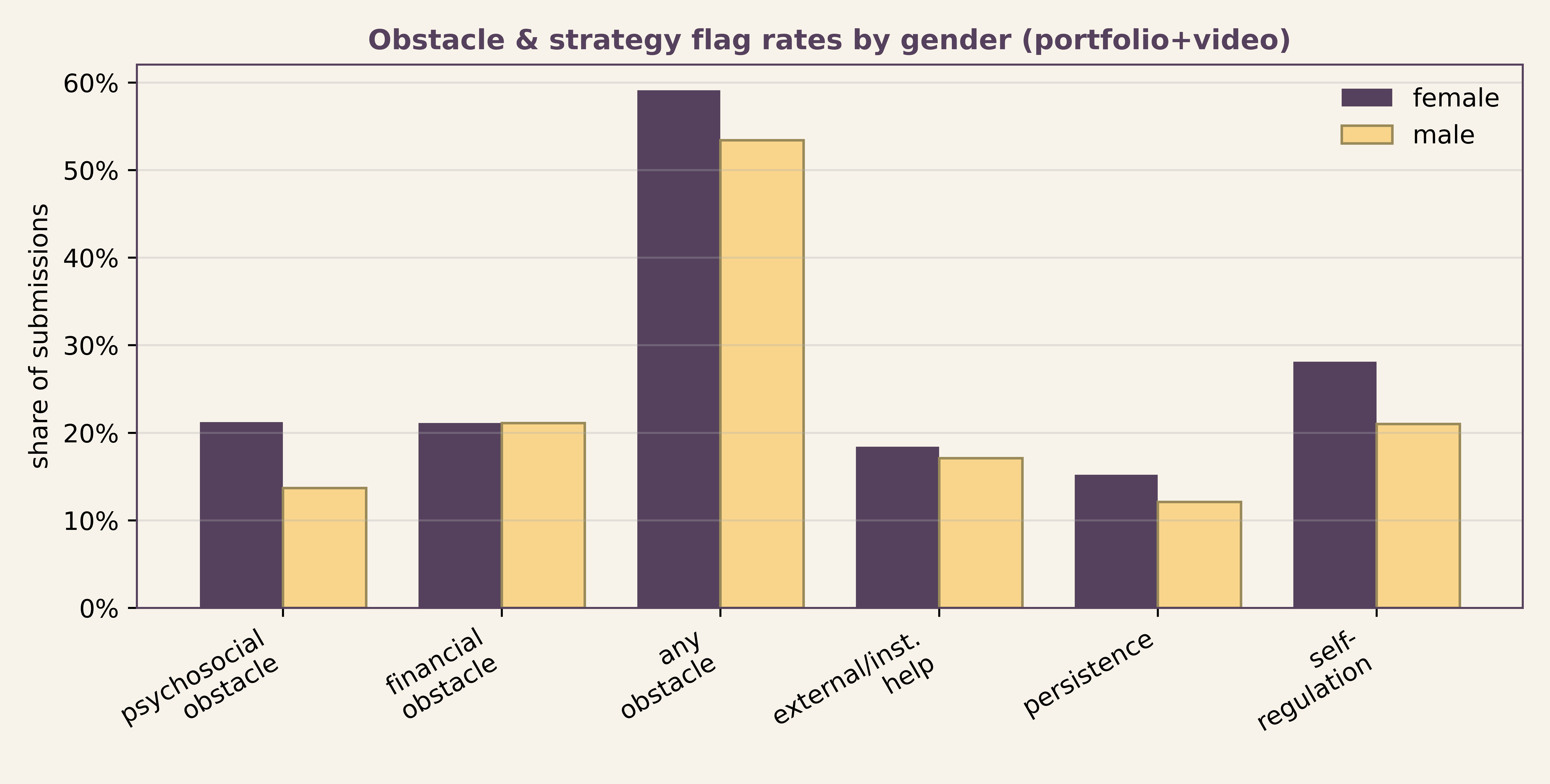
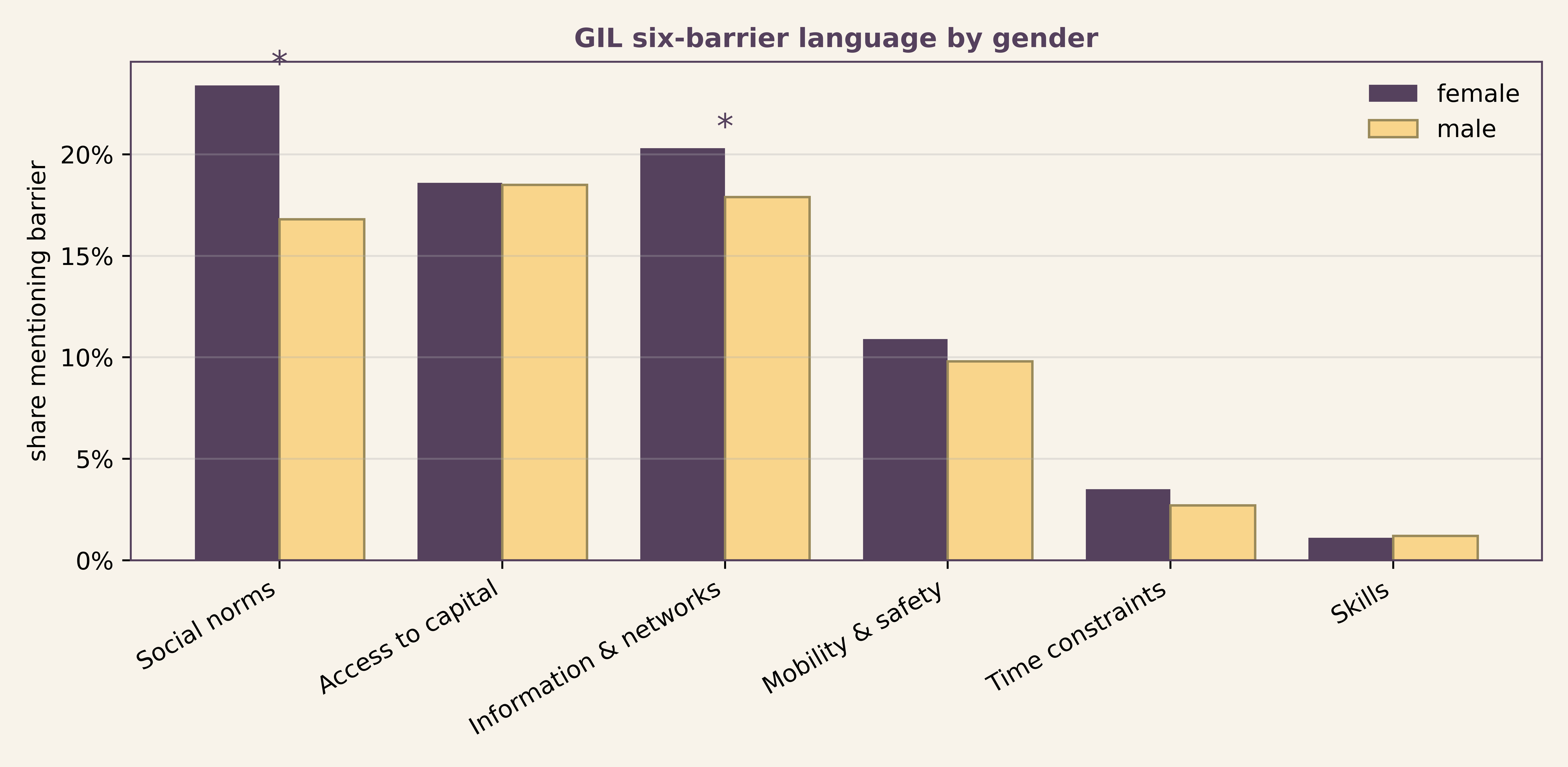
Among Kabakoo learners, obstacles like technical skills and access to finance don’t differ much between women and men. Financial barriers show up almost equally, and skills are rarely named as a primary obstacle by either group. Both young men and women express ambition and a willingness to learn.
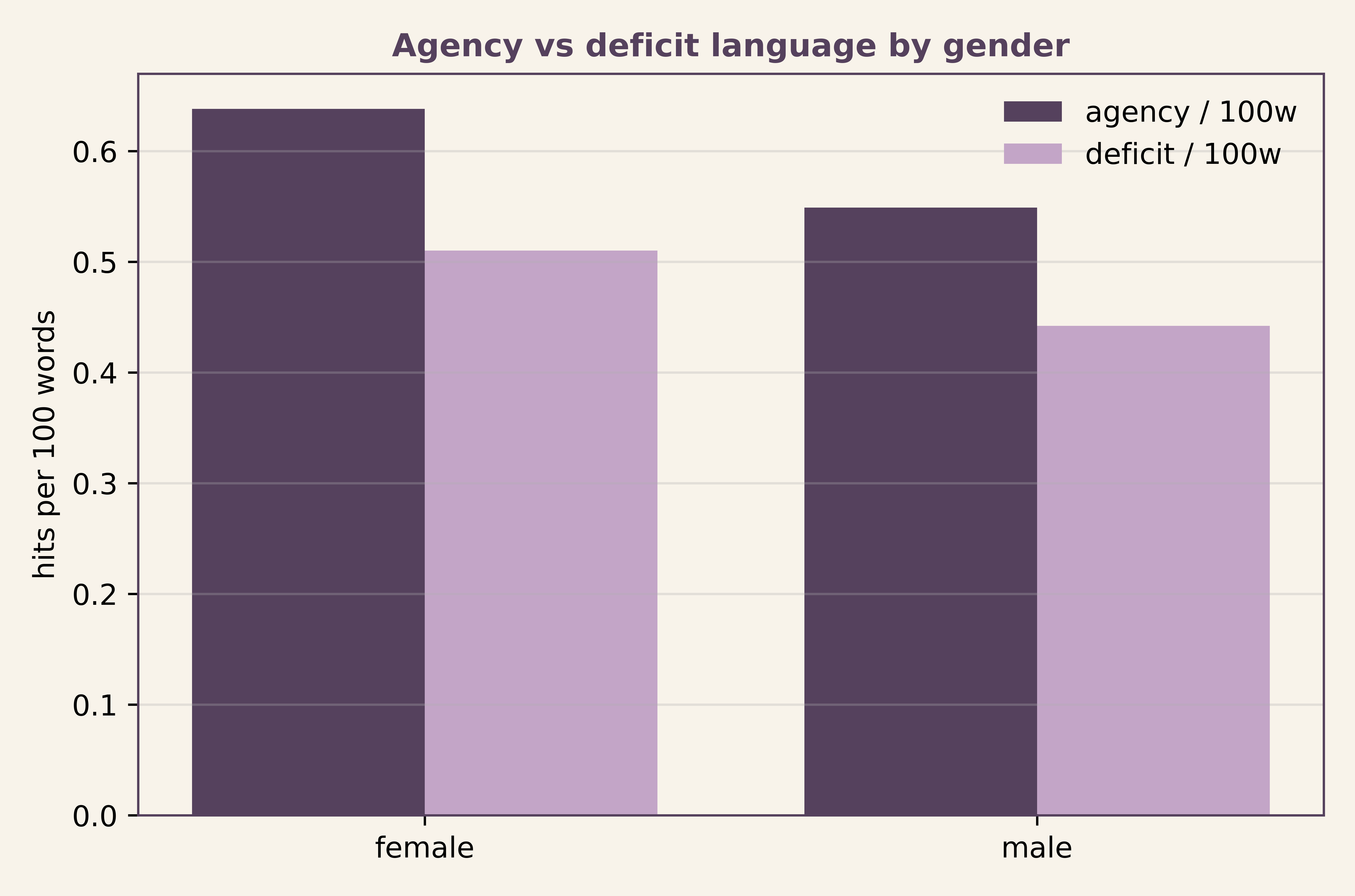
The differences show up at the psychological level, which we have previously called the inner obstacle. Young women are more likely to mention obstacles tied to confidence, fear, and self-doubt (+7.4 pts) and to the burden of social expectations (+6.6 pts). Interestingly, women also express more agency, speaking more about persistence, planning, organization, and self-regulation.
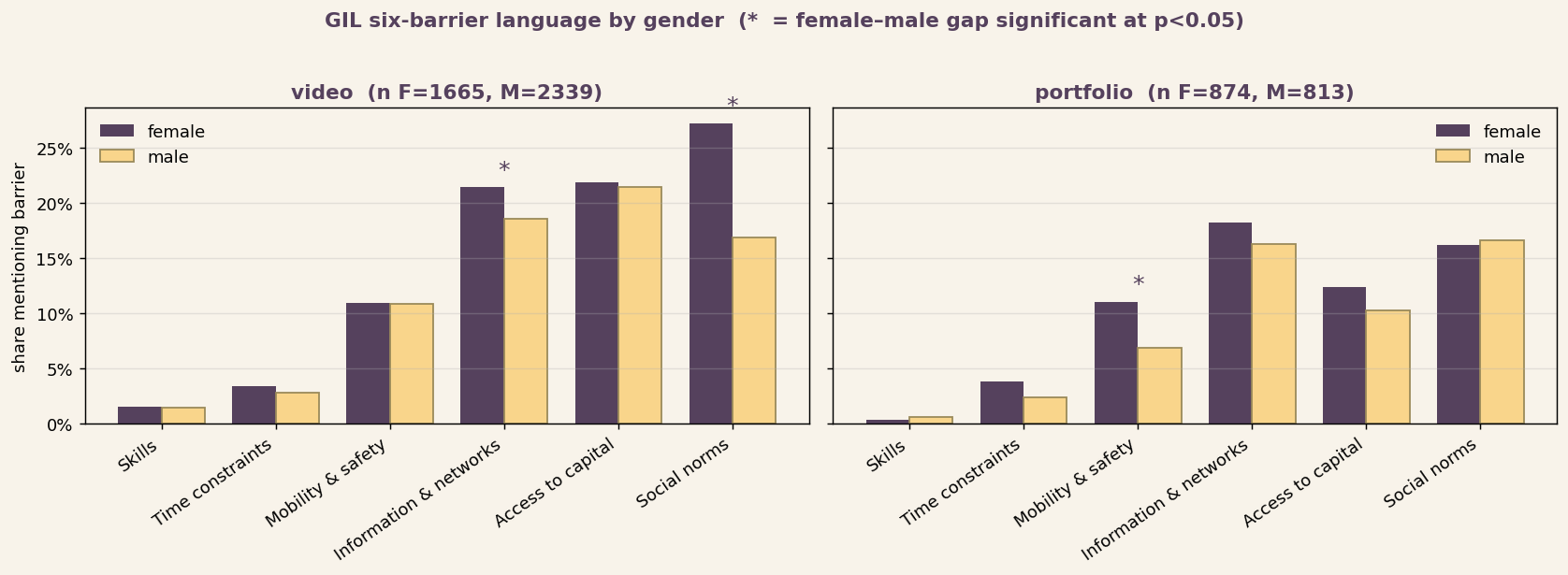
Social norms, then, emerge as the clearest differentiator between women and men. Looking at the data source, we learned that barriers tied to social norms came through far more explicitly in the video reflections from our mindset modules than in written portfolio entries. How we invite learners to reflect hence seems to shape what they feel comfortable sharing.
Most of the design choices that define Kabakoo’s learning ecosystem respond directly to these obstacles. WhatsApp-based delivery lets learners take part in a familiar, trusted environment. Asynchronous learning gives flexibility around family and household responsibilities. Mindset work comes before technical skills, to build confidence and agency. Women mentors and peer communities act as support systems and networks.
These design choices combine agency and confidence, skills, social capital, and real-world opportunity. They are the result of years of listening to our learners, in-house research, and designing around their lived realities.
(With over 42,976 registered learners, each month we spotlight a member of our vibrant community.)
Meet Ithiel M., Product Designer at Kabakoo.
After high school, Ithiel started studying software engineering to chase his goal of becoming a front-end developer. He wanted to build beautiful websites.
At the same time, he was working in a construction-materials shop at the market in Bamako. Serving customers every day put him in front of people from very different backgrounds, many with university degrees but no work. That’s when he began to question his own future.
“I kept asking myself whether I was going to follow the same path and end up in the same situation.”
He joined Kabakoo through a three-day hackathon. It looked like a fun challenge and a way to earn some money. But the prize also included training at Kabakoo, an unexpected opening that Ithiel decided to seize. Worried at first about his family’s reaction, he dropped out of university at just 19 and changed his direction completely.
Before Kabakoo, he believed technical skills were enough. What surprised him most were the mindset modules he had to complete before touching the technical content.
Today, as a Product Designer at Kabakoo, he also facilitates workshops as a peer mentor in web design.
His family struggled at first to understand his choice. Now they recognize his work with pride, even if it leaves him less time to spend with them.
“When they see what we are building today, they understand much better the direction I wanted to take from the beginning.”
As the youngest member of the team, Ithiel goes by the nickname “Young Moti” and dreams of helping millions of young people like him choose their own path with confidence. Watch his full story here.
A simple one this month. If something in this edition (or the previous ones) was worth your time, forward this to one person you think would appreciate it. That’s how most of you who read us found us.