
The Labs | Where our curriculum comes from
Why would a WorkTech run a Textile Lab?
Because the knowledge and craftsmanship embedded in West Africa's endogenous value chains are a source of prosperity, and someone has to make them legible, reproducible, and transmittable. Additionally to the Textile Lab, we run an Urban Agriculture Lab, and a Regenerative Architecture & Design Lab.
Each lab documents knowledge with its holders, experiments on it with learners, and turns it into curriculum. The pavilion and prototypes below are the workshop of our acclaimed pedagogical engine.
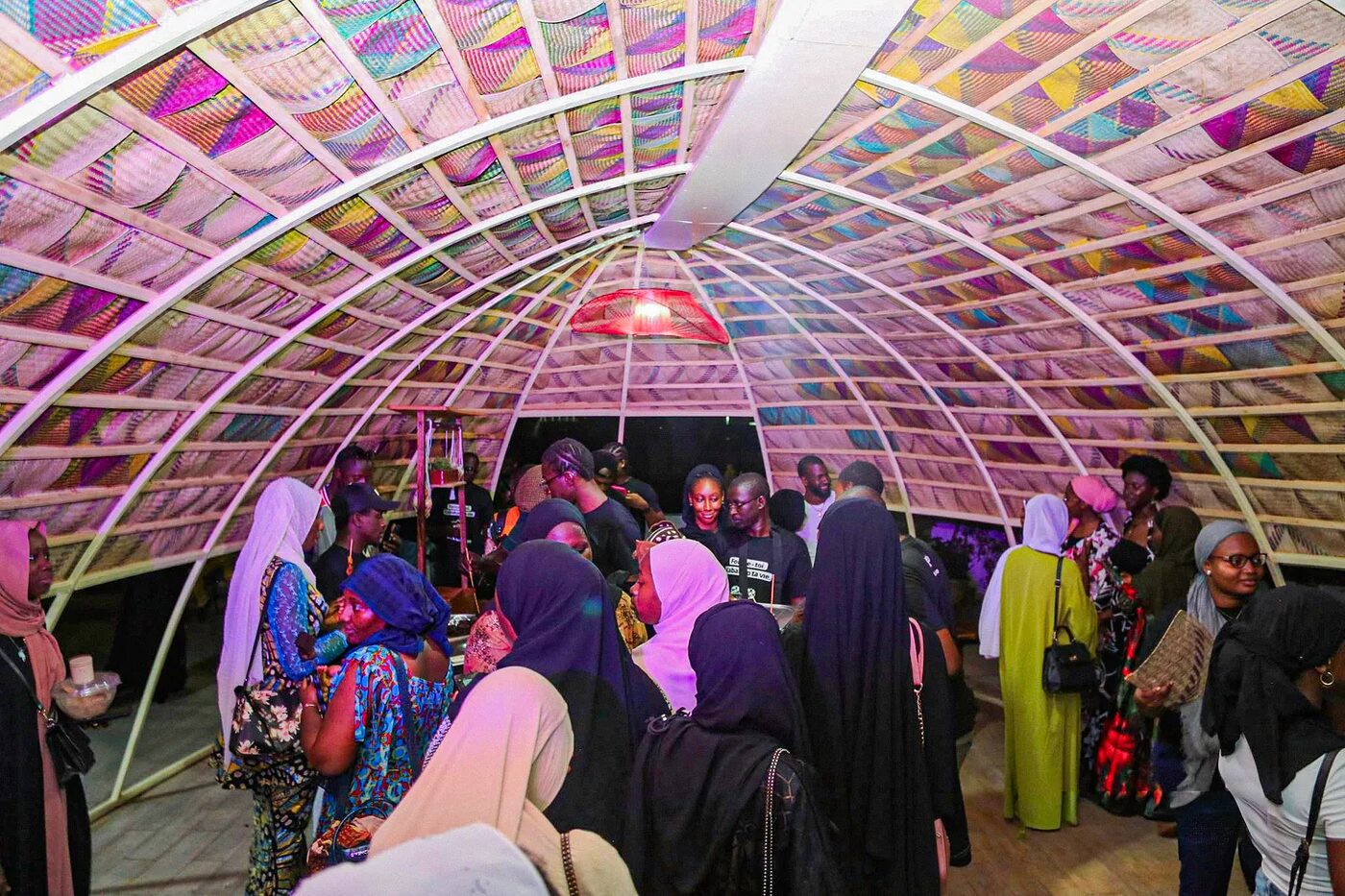
Inside Le Nid de Bamako on opening night: a collective room for learning, music, and debates.
Lab 1 | Food systems
The Urban Agriculture Lab
Regenerative urban agriculture is a standing capability at Kabakoo, with its own coordinator on staff. The lab's work runs from soil to system: learner pods take on urban-agriculture projects as their collaborative work inside the WhatsApp Learning System; an Agri version of the AI Mentor, designed to support farmers and agri-entrepreneurs in local languages, was live-demonstrated at Mali's National Digital Week; and with CFPM Missabougou, a major TVET center in Mali, Kabakoo co-created and digitized full tracks in market gardening, poultry farming, and agrifood processing.
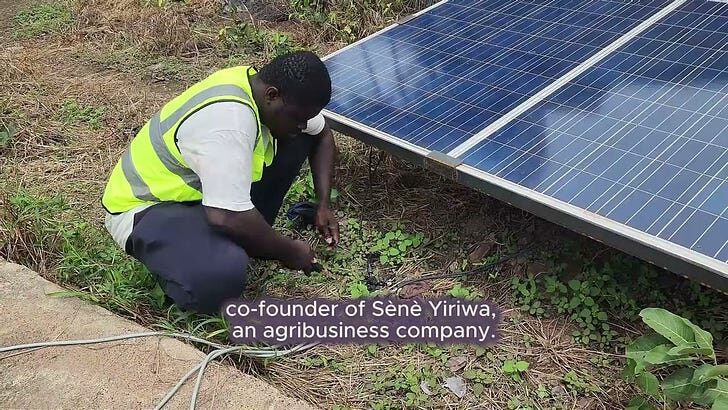
The lab's alumni ventures carry the evidence. Boubou D. built Sènè Yiriwa, an irrigation-systems company for farmers, from a Kabakoo cohort and his own farming knowledge; his story anchors the homepage. And the lab's coordinator embodies the path: Yahaya B. arrived with an agropastoral degree that, in his words, earned no respect, and refused the artisanal gold mines his classmates left for.
"The knowledge I have gained at Kabakoo, I never found anywhere else. My training before and my training now are as different as the water of the river and the fish."
Yahaya B., Coordinator of Regenerative Urban Agriculture at Kabakoo
Today Yahaya trains other youth in regenerative agriculture, in Bamako and in communities across Mali.
Read the full stories in the December 2025 (Yahaya) and March 2026 (the Agri AI Mentor at SENUMA) updates →

Lab 2 | Housing
The Regenerative Architecture & Design Lab
Born as the Regenerative Architecture and Extended Reality program (2023–2025), with 16 masons and master artisans from Tombouctou, Gao, Djenné, Mopti, Ségou, Bamako, Kayes, and the Pays Dogon as knowledge holders. Two of its builds:
Le Nid de Bamako
What happens when centuries-old craftswomanship, contemporary design, and regenerative economics collide. Over six intense weeks, 16 learners, guided by Cheick Diallo (Centre Pompidou, Vitra Design Museum collections), Mamadou Koné (restorer of Timbuktu's UNESCO World Heritage mausoleums), and Samaou Touré, master weaver from Gao, transformed about 2,000 handwoven fans into a 130 m² pavilion. Every module is hand-replaceable; the structure is demountable, powered by an adjacent solar array.
But the real deliverable wasn't the pavilion itself. It was the resilient, agentic problem-solving team that emerged. That is the core of the Highdigenous approach.
TabliCool
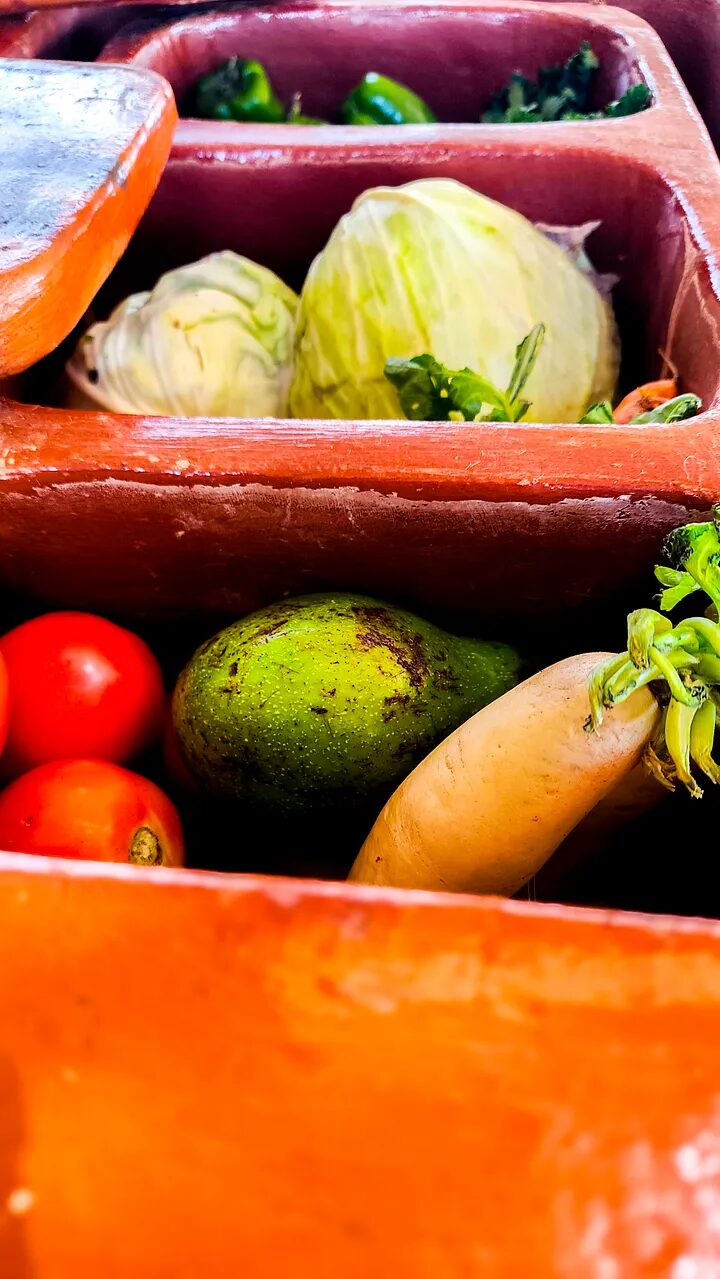
The traditional desert fridge, the zeer, reimagined in a bootcamp with master potter Kadidia Nienta of Mopti, Drissa Camara, grandson of master potter Assitan Doumbia, and CFPM carpenter-trainer Abdoul Dembélé. Clay and wood, cooling without electricity, and a design piece pointing at climate resilience that creates economic value.
Read the full stories in the September 2025 (Le Nid) and November 2025 (TabliCool) updates →
"Whether you are restoring the great mosques of Timbuktu or designing a pavilion from handwoven fans, the fundamental questions are the same: How does the structure breathe? How does it respond to the sun? How does it gather people?"
Mamadou Koné, architect and restorer of Timbuktu's UNESCO World Heritage

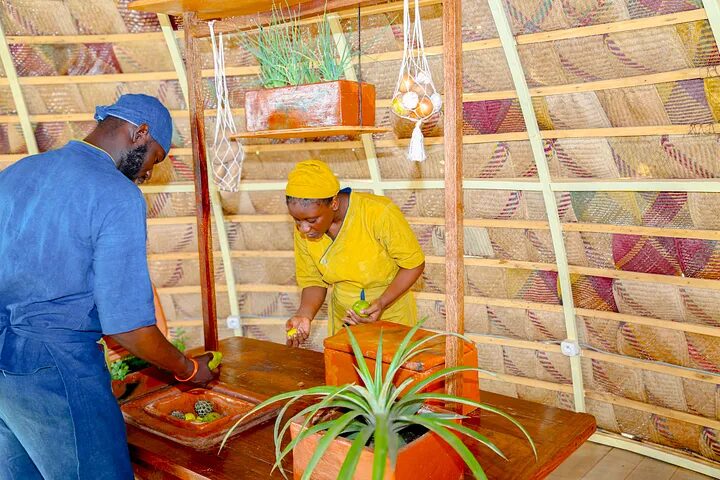
Supporting artisan livelihoods | September 2025 update
11 m long, 7 m wide, over 3 m high
Backgrounds from IT to photography to logistics
Hybrid mentoring across continents
"Yes, this does look beautiful, but is a model like this scalable?" We are not in the business of scaling the creation of pavilions. We are scaling the pedagogical engine that produces skilled, agentic, and collaborative teams. The context changes, the process repeats; the tech backbone supports hundreds of team projects at once; and each project is documented, step by step, into authentic learning videos and pedagogical guides, a permanent, reusable curriculum asset.
Lab 2, the digital wing | Heritage × technology
Where the AI record and the making record meet
Kabakoo learners won Niantic's Real-World Gaming Challenge with an augmented-reality experience of the Great Mosque of Djenné, making the world's largest adobe structure interactively accessible from a smartphone. Dôgôkun Sôrô, "treasure of the week" in Bambara, tells the stories of endogenous architecture on video; the Royal Palaces of Abomey edition passed 200,000 views, the Hombori edition 622,000. At SENUMA, visitors walk Malian heritage sites in VR, and La Voie du Donsoya, an eight-episode AI-generated mini-series on one of West Africa's oldest knowledge systems, was produced by a crew of AI agents directed by Kabakoo staff and learners.
That last production came with its own published caveat: the team ran into biases everywhere, cultural blind spots, stereotypes, narrative distortions, and the learners stepped in to correct imagery and scripts. Reclaiming generative tools for local narratives is work, and Kabakoo documents the work.
Read the full stories in the October 2025 (La Voie du Donsoya, Bamako.ai) and January 2026 (Dôgôkun Sôrô) updates →
Lab 3 | Clothing
The Textile & Fashion Lab
"Where did you buy this?"
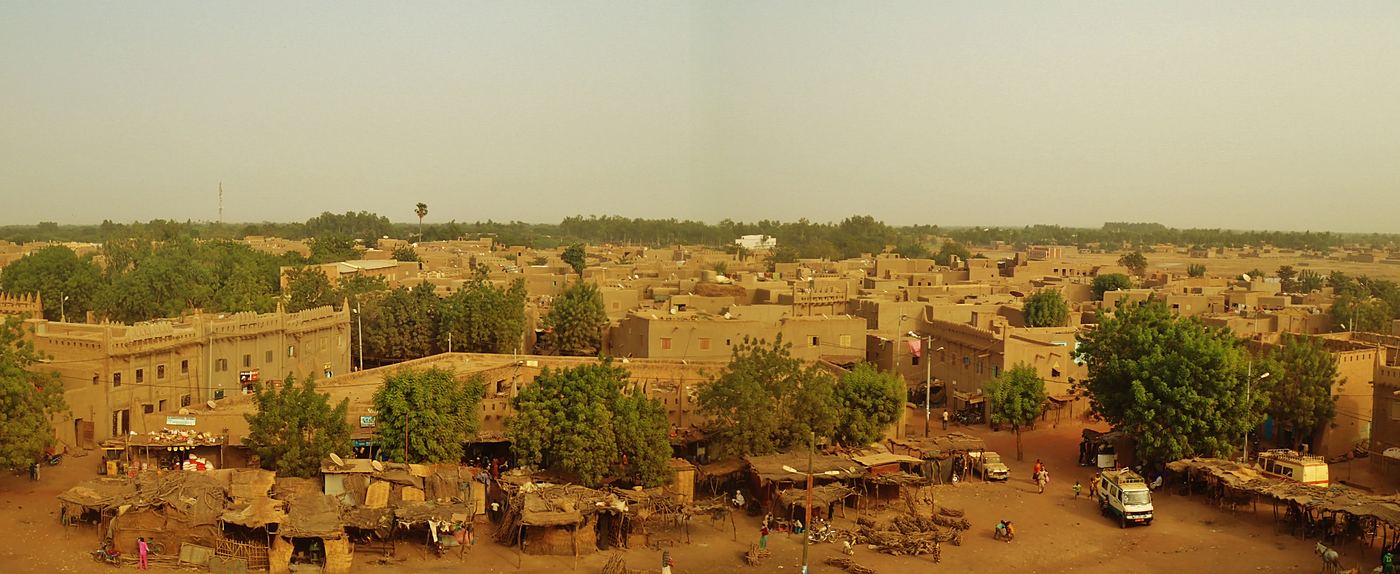
Kabakoo's team gets the question almost every time it travels, about the clothes it wears. From Nairobi to New York, people are drawn to the cloth: deep indigo blues, calm earth tones, handwoven texture. That cloth is the result of centuries-old knowledge, yet the ecosystems that produce it struggle to attract younger generations and to reach markets beyond tourism. There is nothing small about this economy: the Nana Benz, the women wholesalers who ran West Africa's wax-cloth trade out of Lomé's Grand Marché, moved wealth that by the early 1980s rivaled Togo's national phosphate exports. Their work was brand strategy, product development, and market intelligence before anyone used those words.
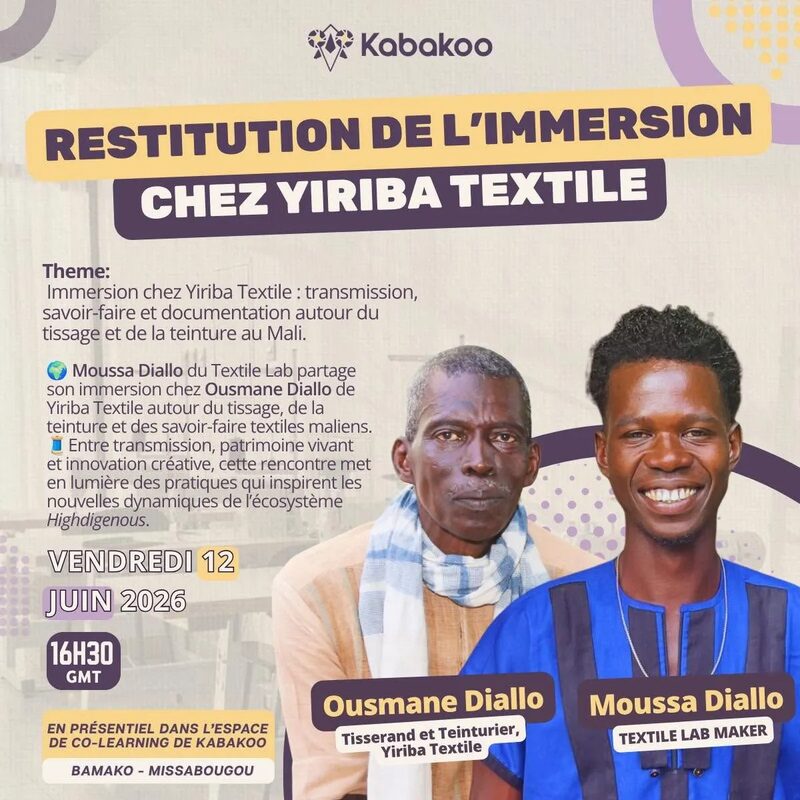
The lab's first learning cycle ran as an immersion in the workshop of Ousmane Diallo, master weaver and one of the last natural-dye experts in Mali, who constantly experiments, develops new motifs, and adapts technologies like the Flying8 loom to raise his productivity. Kabakoo's Textile Lab Maker documented every step, from weaving to plant-based dyeing. Between Ousmane Diallo's first Highdigenous Talk and his welcoming the Lab into his workshop, almost three years passed, the time it takes to build trust.
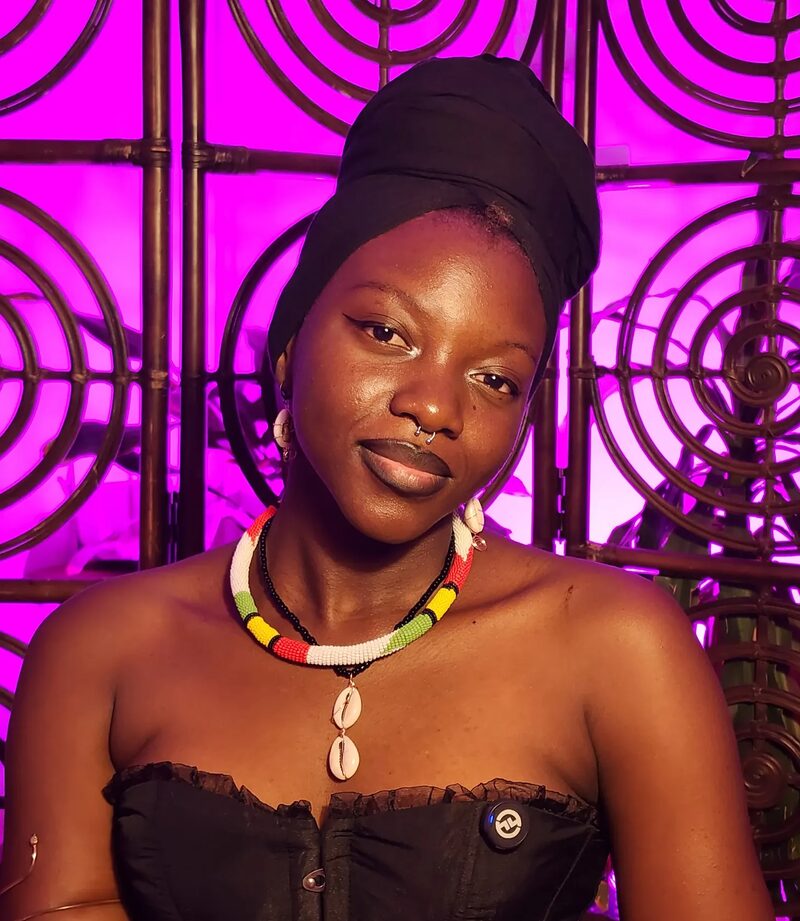
Fashion is the lab's other door, and it's how learners walk in. Kabakoo's Digital Makers program runs a Fashion & Music Biz Track; Mona S. joined it from Burkina Faso dreaming of fashion design, learned web design, no-code, and generative AI, built her brand's identity, and launched her enterprise. At Highdigenous Live!, an afrofuturist costume competition showed how fashion built on local aesthetics can imagine new images and address international markets.
Read the full stories in the July 2026 (the Lab's first cycle) and August 2026 (Mona) updates, and the Nana Benz argument in full →
"More importantly, it builds both the expertise and the legitimacy we need to work with public and national bodies on upskilling programs rooted in local value chains. It's how we were able to join forces with public institutions and partners to digitize public vocational training centers in Mali."
Why a WorkTech runs a Textile Lab | Kabakoo monthly update, July 2026
What the labs buy
From workshop to national mandate, in three steps
Expertise and legitimacy
Documented knowledge of real value chains, and working relationships with the master artisans and instructors who hold it.
Public systems open their doors
That legitimacy is how Kabakoo digitized CFPM Missabougou, a major TVET center in Mali: 300+ interactive videos across three tracks, and became a strategic partner of Mali's National Digital Week three years running.
A national program
In August 2026, enrollment opened for the national upskilling program under the Prime Minister's authority: a shared ambition of 15,000 youth by end-2027.